As I mentioned below the main part of my trip to Zamboanga was focused on my research. For any of you interested in how that’s going, read on!
I don’t know if I mentioned it before, but I am doing research for my Master’s on the use of interfaith rituals as a form of grassroots peacebuilding. I want to learn how these rituals are used, why, with what effect, and how they can be improved to build even more peace. From what I have learned so far interfaith rituals are a popular and often used tool for grassroots peacebuilding in the Mindanao context. Many of my interviewees stated that interfaith rituals help the participants realize they worship one God and share many commonalities among their religions. Interreligious dialogue, in general, allows for a space in which Muslims, Christians, and Indigenous Peoples can learn about each other and break down prejudice and biases. Interfaith rituals help this process in particular because they have a mystical quality to them; many have said there is just something there that brings together the participants. It also seems to me that interfaith rituals are quick and easy proof that the tri-people can do something together. Interfaith dialogue can sometimes be all talk about respect, collaboration, and peace, but an interfaith ritual can easily, quickly, and meaningfully put this talk into practice (working on a social action event, for example, while also meaningful proof of collaboration and respect takes much more time, work, and investment than a ritual like spontaneous prayer).
However, my interviews have also raised a ton of questions for me. There were uncomfortable moments during my interviews and focus groups discussions in which people stepped on each other’s toes and upset someone from another faith tradition. Sometimes it seemed to me that some of my interviewees didn’t have a deep understanding of the faith tradition of others, even though they had been heavily involved in interreligious dialogue. Many interviewees also told me that they do not participate in the rituals of other’s religion, but only observe. Only Muslims could actually participate in Muslim rituals and vice versa with Christians. It became obvious that many are only comfortable with interreligious dialogue if a strict divide is maintained between the religions.
Now I am at the stage of trying to formulate my questions and figure out where to go next. First, there is a question over depth of dialogue. I was a little upset by the lack of understanding some interviewees had of each other’s faith traditions. Is a deep understanding necessary though? Do they need to have deep knowledge of each other’s doctrine and practices, or is the fact that they sit together and are tolerant of one another the main goal? Is tolerance and respect all that is needed for peace here in Mindanao, or should interreligious dialogue progress to try to attain something deeper? And how do I even begin to judge the level of “depth” of dialogue?
I am also struck by the use of the word “participate.” What does it mean to “participate” in the rituals of another faith? Is merely witnessing a form of participating? Is it participating if you are present at the ritual and pray to your own God during this time? But everyone told me that they believed everyone shared the same God, so if we all have the same God, why can people not actively participate in each other’s rituals? How does this issue of participation affect peacebuilding? Does the level of participation engaged in by the participants affect the amount of peace built from this experience? Or again, is just getting the tri-people to sit together at a ritual, regardless of how participation is interpreted, what brings about peace? Many said that interreligious dialogue bridges gaps among the tri-people, but which gaps are being bridged if the tri-people want to maintain separate in some ways? What separation is necessary to overcome for peace and what is okay to live with for the sake of protecting one’s culture and traditions?
Lastly, everyone answers that interreligious dialogue helps bring together Muslims, Christians, and Indigenous, but I want to dig deeper as to why. Why is interreligious dialogue or rituals any better or worse a peacebuilding tool than any other strategy? What does it uniquely have to offer, if anything, and why?
Throughout all this I’m also still learning how to be a better researcher. How do I rephrase questions that aren’t clear? Where is the line in using leading questions? When should I ask further questions of an interviewee and when should I simply interpret the interviewees questions based on my own background research and opinion?
Anyone have some answers or advice for me? :)
Tuesday, September 21, 2010

Monday, September 20, 2010
My Trip to Zamboanga
I still haven't told you about my trip to Zamboanga, and it was a week and a half ago! I've been putting this post off because the trip was so rich and I did so much in such a short time that it has been hard for me to think how to boil this down into one post! I'm just going to go ahead and give it a try!
Just to give some background Zamboanga is located on the Western part of the island. Zamboanga has a bad reputation largely because it has been associated with being victimized by activities of Abu Sayyaf, an extremist organization associated with Al Qaeda that is headquartered on the small islands south of Zamboanga city. Abu Sayyaf has had a past of kidnapping people in Zamboanga, particularly in 2008 when there was a surge of kidnapping of humanitarian workers. Just this past August there was a bombing in the airport over some political issues. The bomb was aimed to kill just one person, which it didn't, it only killed the person carrying the bomb. Lastly, one day before we left 2 Abu Sayyaf members were killed so all Mindanao police were on high alert when we left on our trip. I was a bit nervous, but I was with many people and I trusted these people to not take me anywhere I would be in real danger. Everything ended up being perfectly safe.

Just to give some background Zamboanga is located on the Western part of the island. Zamboanga has a bad reputation largely because it has been associated with being victimized by activities of Abu Sayyaf, an extremist organization associated with Al Qaeda that is headquartered on the small islands south of Zamboanga city. Abu Sayyaf has had a past of kidnapping people in Zamboanga, particularly in 2008 when there was a surge of kidnapping of humanitarian workers. Just this past August there was a bombing in the airport over some political issues. The bomb was aimed to kill just one person, which it didn't, it only killed the person carrying the bomb. Lastly, one day before we left 2 Abu Sayyaf members were killed so all Mindanao police were on high alert when we left on our trip. I was a bit nervous, but I was with many people and I trusted these people to not take me anywhere I would be in real danger. Everything ended up being perfectly safe.

I went on this trip with Catholic Relief Services,
And what a week it was! PAZ organized a week chock full of interviews and focus group discussions and community visits for my research. As exhausting as it was I was able to get an ample amount of information for my research. During the week I interviewed directors of peace institutes at both
Zamboanga is a beautiful city. Largely untouched by tourism and development since many are afraid to travel to this area, the area has kept many original buildings, such as the 16th century Spanish fort and the Spanish town hall. While the area has been preserved a bit because of the conflict (one positive?), it is also much poorer than
 The City Hall with Rizal park in the foreground
taken from: http://www.zamboanga.com/html/funsun2.htm
 Fort Pilar
Taken from: http://travel.webshots.com/photo/1018401048000101585iwKcMzqinM
 The altar at Forth Pilar
Taken from: http://pamelaalfaro.wordpress.com/2007/10/14/que-haces-tu-
en-zamboanga/
 The Muslim village of Mariki
 Fort Pilar
Taken from: http://travel.webshots.com/photo/1018401048000101585iwKcMzqinM
 The altar at Forth Pilar
Taken from: http://pamelaalfaro.wordpress.com/2007/10/14/que-haces-tu-
en-zamboanga/
 The Muslim village of Mariki
Taken from: http://kenny-macrohon.blogspot.com/2009_08_01_archive.html
One of the highlights of the trip was the people I was able to meet. The youth we met are amazing and could already have an MA in Peace Studies from Notre Dame about three times over from all the peace camps and peace advocacy they have been engaged in. The staff of PAZ were warm, smart, and passionate about peace. And my interviewees were quite inspiring from the amount of work they had done for peace. Overall, I felt quite inspired and refreshed from my trip to Zamboanga. The warmth and welcome I received from the people there reminded me of the responsibility I have to bring the voices of the people I have encountered in Mindanao back to the
Saturday, September 11, 2010
American Forces in the Philippines
Here in the Philippines there are a number of U.S. military. The Philippines has a "Visiting Forces Agreement (VFA)" with the U.S. From my limited knowledge, one of the main reasons for these forces to be here is to try to contain the spread of influence of the extremist group Abu Sayyaf. This group is based on the islands off of Western Mindanao, in Jolo and Basilan. Wikipedia says they are in Zamboanga as well but I was just there and all the residents swore up and down Abu Sayyaf isn't there (they were also trying to make a good impression though and still wouldn't let us go to places, where in the past, kidnappings of foreigners has occurred).
My initial reaction to learning about the VFA was dislike - I am in peace studies after all! Seriously, though (I don't want to give the impression that all peace studies kids are completely anti-war and hippies like me!), I learned about the VFA while reading a document published by my organization condemning it. I also learned around that time of an incident of a woman being raped by American forces here. I was learning all the negative issues revolving around the VFA.
I hadn't actually seen any U.S. military here until last week when out at a nightclub. I ended up chatting with a U.S. born Filipino in the army. His job in the army is working in the civilian affairs unit. He explained that his mission is purely humanitarian. He told me how he goes into villages and listens and takes notes of what the people there want or are in need of. Then his team goes into action and builds schools or water projects, etc. It was my interpretation that part of the objective of these missions was to engage with Filipinos and improve their lives in the hope of avoiding the infiltration of the influence of Abu Sayyaf. He was a little wary of being judged for his work -- he stated that a few bad apples in the military make everyone look really, really bad. I was really impressed by how genuinely passionate he seemed about helping Filipinos and bringing peace into their lives. We then launched into a conversation about how trained peacebuilders and trained military need to work together, to him we all have the same objective.
And its true, we do need to work together. As far as I can tell, there is a lot of unspoken (and not so unspoken) animosity between some professional peacebuilders and the military. We are often viewed as having antithetical stances. And yes, we do sometimes have antithetical ideas about how we should get to peace and what that peace is supposed to look like. I, myself, am quite a peacenik and like to protest against certain U.S. foreign policies, military structures and the overall culture of militarism in American society. But I really do try to think well of individuals in the military. I have been blessed with one particular amazing friend in my life who is currently serving in Afghanistan and is doing so because she genuinely wants to help and bring peace. She, and the man I met here in the Philippines, continually remind me that as much as I just want to "rage against the machine" sometimes, the world isn't that black and white. There are people in the military who choose their job because they believe this is where they can bring peace to people around the world. Peacebuilders like me could do much better if we learn about the military, its ins and outs, its language, and engage it respectfully. Continual animosity of professional peacebuilders towards the military is neither peaceful nor productive. Through respectful engagement professional peacebuilders and military personnel can challenge each other's ideas, positively influence one another, and refine our strategies to be the best and most peace-loving practitioners we can be.
Praying for Peace
This past week I spent in Zamboanga City, in the western part of Mindanao, conducting research for my future master's paper. I'll be sure to put up a blog post soon about that but I forgot my camera and I want to try to wait for photos of my trip from my new friends.
While I was there, however, I broke the fast with my Muslim friends in a community mosque. My prayer there, of course, was for peace, in Zamboanga, in Mindanao, in relations among Christians and Muslims and beyond. At the Catholic retreat center I stayed in while in Zamboanga I woke every day feeling refreshed and peaceful. I could only thank God for that and pray that people all around the world can feel this same calm. Today, upon my return back to Davao my classmate, Chernor and I, headed to two Chinese temples here, one Buddhist, the other Taoist. I conjured up my World Religions classes in undergrad and gathered inspiration from the "Eighfold Path" and "The Way." I lit incense, kneeled, and made prayers for peace and love across the world, particularly on this September 11th. I hope someone's (or some might say everyone's) God is listening...
 The front of the Buddhist temple
 Who doesn't love a koi pond!?
 The main altar
 Another prayer area, where we lit incense
 This was one of the beautiful carvings on the wall depicting the
eight major moments of the Buddha's life
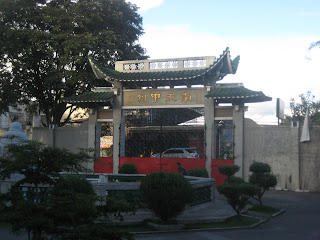 The main gate to the Buddhist temple
 Another temple!

 The main altar in the Taoist temple.
I love the Octagon shape, such nostalgia for
St. Joseph Worker Days at the Dwelling Retreat Center.
 There were Tibetan singing bowls at both temples,
but I liked the one in the Tao temple better, is was simple but larger.
I also have such nostalgia for these bowls, here's looking at you Sisters of St. Joseph!
 Yes, that is Jesus and his Sacred Heart among the other statues.
 On the right side of the altar you can see the caretaker of the temple. Chernor and I chatted that, as much as we love our work, there is something beautiful about leading a life of simple dedication to something like looking after a temple.
 Getting some balance in life!
While I was there, however, I broke the fast with my Muslim friends in a community mosque. My prayer there, of course, was for peace, in Zamboanga, in Mindanao, in relations among Christians and Muslims and beyond. At the Catholic retreat center I stayed in while in Zamboanga I woke every day feeling refreshed and peaceful. I could only thank God for that and pray that people all around the world can feel this same calm. Today, upon my return back to Davao my classmate, Chernor and I, headed to two Chinese temples here, one Buddhist, the other Taoist. I conjured up my World Religions classes in undergrad and gathered inspiration from the "Eighfold Path" and "The Way." I lit incense, kneeled, and made prayers for peace and love across the world, particularly on this September 11th. I hope someone's (or some might say everyone's) God is listening...
 The front of the Buddhist temple
 Who doesn't love a koi pond!?
 The main altar
 Another prayer area, where we lit incense
 This was one of the beautiful carvings on the wall depicting the
eight major moments of the Buddha's life
 The main gate to the Buddhist temple
 Another temple!

 The main altar in the Taoist temple.
I love the Octagon shape, such nostalgia for
St. Joseph Worker Days at the Dwelling Retreat Center.
 There were Tibetan singing bowls at both temples,
but I liked the one in the Tao temple better, is was simple but larger.
I also have such nostalgia for these bowls, here's looking at you Sisters of St. Joseph!
 Yes, that is Jesus and his Sacred Heart among the other statues.
 On the right side of the altar you can see the caretaker of the temple. Chernor and I chatted that, as much as we love our work, there is something beautiful about leading a life of simple dedication to something like looking after a temple.
 Getting some balance in life!
Monday, September 6, 2010
On a related note to my previous post I want to talk about a sensitive subject for me here in the Philippines, and maybe solicit some thoughts on this. I wanted to write about it in my last post, but there just wasn’t enough space (I write long enough already, right!?). So the topic for today is American (or white, born in developed countries) men who travel to the Philippines to marry a Filipina. Here in Mindanao if you do see another white person, it is almost always an older white man, anywhere from his 30s-60s, with a Filipina.
I’m just going to own my prejudice here and say I really don’t like it. Having worked with trafficking and domestic violence victims – about half from Southeast Asian countries, I’m extremely uncomfortable with this. I have seen the absolute worst of what can happen in these situations and I worry so much for these women. A few days ago when Chernor and I went out dancing there was this older, slightly overweight, unattractive (by American standards) white man with two young, scantily clad Filipinas grinding on him as he just stood there, drinking his beer, and looking around. I just kind of gave him this look like, “seriously?” I’m really trying not to judge but it is proving quite difficult for me.
On the other hand, I want to support interracial dating – as a few of my friends have been joking for a while now, it could be a good peacebuilding tool! Seriously though, people do just have different preferences for the looks and personalities of their partners. I’ve also done a lot of research on mail-order brides, particularly from the Philippines. Many of these women are educated, self-sufficient and they think they will get more respect and opportunities from a Western, progressive man. They can end up in completely fine and happy partnered relationships. I have friends here who have dated white men, and that doesn’t bother me really at all; I know them, I know they respect themselves, and I hope they wouldn’t let a man disrespect or hurt them.
In the middle are issues regarding feminists from developed countries versus feminists from developing countries. There is a large shift in thinking right now going on within feminism – feminist from developing countries are telling feminists from developed countries, “You don’t know our situation at all, this is not your lived experience, please stop speaking for us!” Who am I to make any judgment at all about any of these Filipinas? I have no idea of their experience. I want to understand that for women here marriage with a man who can provide for you and secure your future is seriously important. That the kind of men who marry abroad won’t only take you home to force you into domestic servitude or pimp you out. I want to understand that there is love too among white men and Filipinas and its not all about money for everyone. And perhaps even if there are financial concerns involved, that that doesn’t take away from the romantic aspect. Or maybe that the romantic aspect isn’t a crucial element of the conception of marriage here. Or maybe it just all depends on the individual.
But I really can’t.
I really don’t understand. In the U.S., as a privileged woman, I can basically do whatever I want in life and be completely financially secure without a man. I can also choose who I want to love and how, free of almost any hindrances. I don't understand, but I want to. I’m glad this shift in thinking is happening within feminism, it is much needed and I think there is much truth to the words of the feminists from developing countries. My hope is that us Western feminists listen up and take notes, and that, slowly, an equal partnership emerges among feminists around the globe – our ideas converge (although we don’t always have to agree), and we learn to support and stand in solidarity with each other, in whatever form that takes.
Here in the Philippines I get a lot of attention. My classmate and I both do – we look extremely different than most people here so we easily stand out. In Mindanao, there isn’t a huge presence of foreigners either, so it may not be an everyday occurrence for people to see a white person. (It definitely is not an everyday occurrence for the people here to meet a black man, or anyone from the whole continent of Africa.)
A lot of it is just stares or coy looks but many times I get, from both men and women, “You’re beautiful!” (Yesterday this man from his tractor trailer that he just parked scrambled out of his seat while I was walking by to yell after me “I love you!”) At first the attention was a little much, especially from men. I’m quite protective of myself as a woman, and in a new culture and country you have no idea really what the implications of men calling out to you is, are they harmless or not?
I’ve learned now that most Filipino men are quite harmless and most people here are just playful, and I can be friendly back and say Good Afternoon (no I love you toos though!).
But there is something still bothering me a bit about all this attention. A little part of me feels sad when the women look at me and say “You’re beautiful!” Afterwards, they look down at the the pale skin on my arms. My skin tone, my features, my height, maybe my hair are all viewed as desirable, perhaps exotic features. This comes as quite a shock to me since I’ve been a normal looking American all my life. And in my country Asian women, with soft skin, dark hair, and petite figure are the picture of beauty (and are sometimes quite unfairly exploited for their beauty as well). I try to remember to look at these women who compliment me and remind them “You’re beautiful!”
It’s just so mind boggling to me – concepts of beauty. Where did it all start? How have conceptions of beauty come to evolve so differently in different places all around the world? How come I’m so beautiful here in the Philippines but these women would be God’s gift to men (and women!) in my country? Of course, having conceptions of beauty is fine and natural, but what I don’t like is one-dimensional conceptions of beauty. I’m uncomfortable with beauty being just one version of one type of a person (a person who may never exist in reality) that young girls struggle to attain and have low self-esteem and eating disorders because of this for years. I’m uncomfortable with beauty that comes from an affinity for those who have power and riches in one’s country, those who may look closest to the colonizers, and were thus favored by them accordingly, those who have lighter skin.
We’re human, and our minds work in categories. We simplify things to understand. Understanding beauty is no exception. But our, often limited conceptions of beauty, like all narrow thinking, have serious ramifications. I’m not sure I have any answers to or conclusions to these thoughts; other than I think it is important to cultivate an appreciation of beauty in all people and in all of creation.
On an adorable side note, today we went to a village in Zamboanga in Western Mindanao to celebrate Iftar, the breaking of the fast. There were all these little kids following Chernor and I, staring at us, and one brave soul who just stepped forward and pointed straight at Chernor. Later when we passed them again the little boys (maybe 7 or 8?) said “Hello, American!” I looked at them and said all playful, “How do you know I’m American!?” They just stared at me and smiled like, duh, you look so American! They were so precious!
Saturday, September 4, 2010
Random Weekend Impressions
Again, I have waited quite a while to post, so sorry dear readers! I have quite a few ideas I've been mulling over lately and will for sure get some (hopefully) thought-provoking posts up soon, but until then, here are some thoughts from my weekend.
This weekend I spent by sharing interfaith prayer on Friday, starting scuba diving lessons on Saturday, dancing at night, and having some great conversations with new and not so new friends.
Mostly, I'm having this quite new feeling of being happy to be American. As most of you know I have many, many issues with the U.S. system, politics, and, especially now, our current state of (in)tolerance and (lack of)progressiveness. But there are so many parts of me that are so American I didn't even realize until I spent considerable time here. I don't know if I can even name them. But it is so apparent when I meet other Americans and there is automatically this level of understanding and commonality between us that is lacking in other relationships here. It is truly a privilege to learn from other cultures and have the challenge of relating, but there is nothing like knowing that someone just gets you and where you are from in a place where you are so different. This weekend I met some military men from the U.S. (I'll talk more about them later...) as well as took my scuba diving lesson with U.S. Veterans. I have rarely conversed with Americans since I have arrived here, there aren't a lot of foreigners in general and we try to be cool and not congregate together. It was just really nice to connect with home for a bit. I've felt even a little proud to be American and a little hopeful for our future after speaking with these peace-loving Army men. Things aren't perfect in the U.S., but they aren't anywhere. I have always wanted to make things better in my country, which I just now realize means I love my country. If I hated it I would just move to Canada and not care less...
That being said, however, there are multiple ways you can connect with people. I chatted up my scuba diving instructor more than my American partners because he was way closer to my age and we were talking about the "Davao party scene." Women from any culture I connect with on another level, for example.
I guess that is part of the beauty of humanity, down at our core, we really share something quite unique with one another. When you travel you really get this experience of finding the myriad of ways you can make connections with complete strangers in a new place. And that is something we spoke a lot about at our interfaith prayer -- finding commonalities through difference. Its not like we can only connect among our commonalities, but its a starting point -- and the work of peacebuilders is surely to help those who feel so different and antagonistic towards one another find some way to connect, to share.
I truly love meeting new people and hearing their stories, we often forget to do this in our daily lives, but are forced to when we travel. This post started out with me talking about being American, but I guess I have rambled on to this point -- I have some serious overflowing love for humanity today. I don't know how it happened, but a weekend of prayer, scuba, and dancing somehow reminded me of how beautiful this life, world, and the people in it are.
Subscribe to:
Posts (Atom)