Tuesday, October 19, 2010

Boracay R&R

Dear Blog Readers,

I have been away for quite some time and apologize dearly! This past month has been quite busy, as I have been on travel, getting work done when I am in Davao, and preparing for David's visit. One trip I went on was to the island of Boracay with my workplace. Boracay is one of the top tourist destinations in the Philippines -- beautiful beaches, foreigners from all over the world, and delicious food. Boracay is in the Visayas, which are the set of island in the middle of the Philippines, south of Luzon and north of Mindanao. The staff went to Boracay for rest and relaxation and luckily there was room in the budget for me!

Here are some pictures from the trip, I put some up on facebook, but here are a few different ones and more description.

To get to Boracay you have to take a 10 minute boat ride from the main island of Panay:

Here is a pool side picture of our resort:

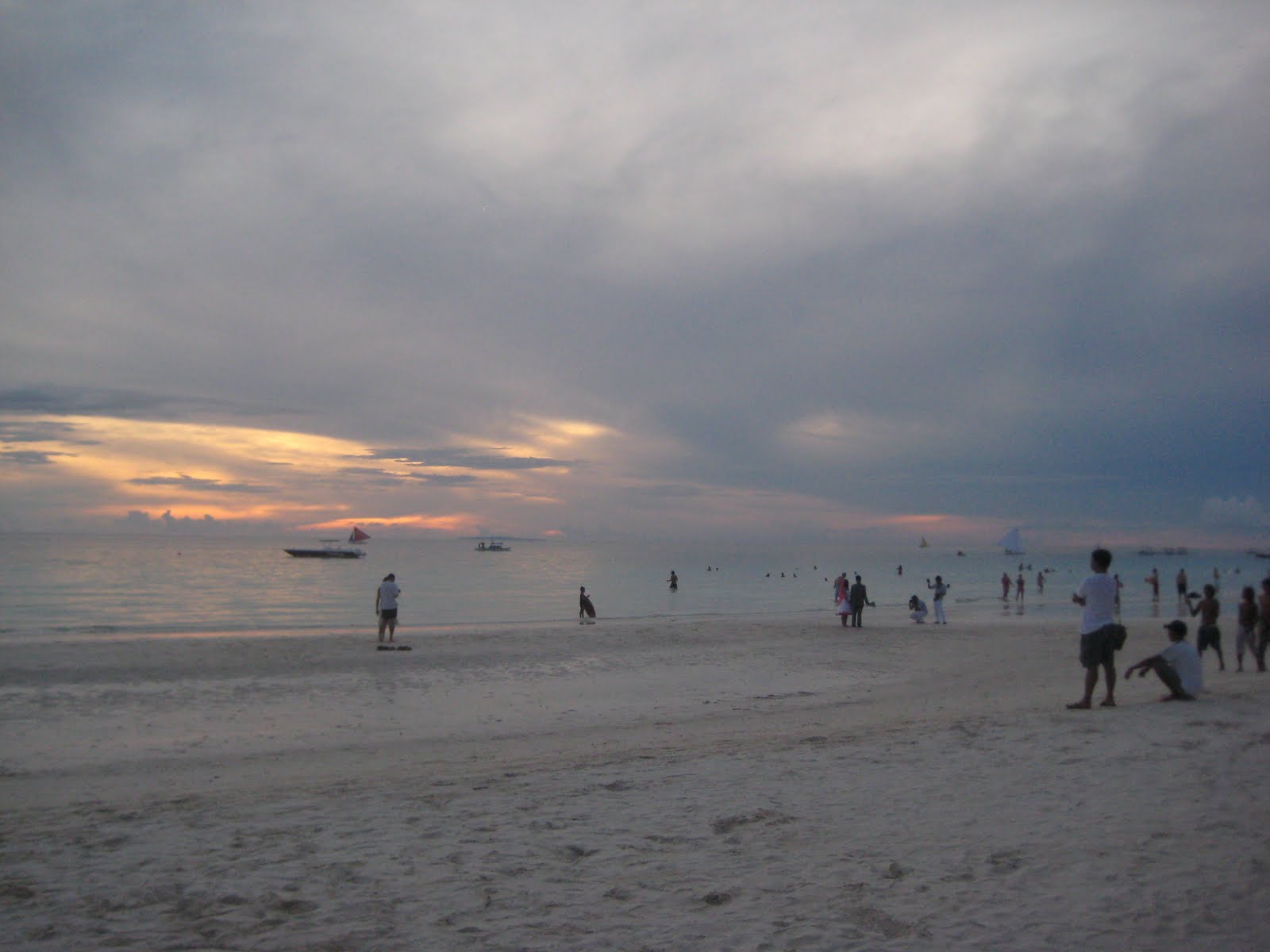
Here are pictures of the beach from the resort:


Later that night we went to eat dinner. We went to a place where there is a market with fresh seafood on one side and restaurants to which you bring your market purchases on the other and they cook it for you in any Filipino style -- this is about as fresh as you can get! Here is a picture of the market:

After dinner we walked around Station 2, the part of Boracay where there are a lot of restaurants and bars:

When we got to Station 1, where our resort is, I came across this restaurant and had to take a picture:

Sadly, every time I passed the Obama Bar and Grill it was empty :(

The next day we went on a boat tour around the island:


Our first stop was snorkeling, where we got to see lots of fun fish:

Our second stop was cave swimming. Here is the first cave:


We trek to the second cave:

This is the opening to the second cave:


But you have to crawl through a tunnel,


To get to swim in the second cave:


This is Puka Beach, full of puka shells. There are tons of women and men here selling jewelry made from puka shells to tourists. During our boat tour we stopped here for lunch:

While one side of Boracay is all white sand beaches, the other is rocky cliffs:

At the end of the boat tour we had the opportunity to do some water sports. Some went helmet diving (a light form of SCUBA), others went on inflatable floats attached to the back of the boat, and some of us went parasailing. Here we are on the boat getting ready to go:

Raquel and I in the air:

Parasailing was beautiful. It doesn't feel very fast in the air, just as though you are floating. You can see so far and it is so calm and peaceful.

So that was my trip! Goodbye beautiful Boracay:


Next up -- pictures from my trip to Thailand!

Friday, October 1, 2010

Illegal

Well I am officially an illegal immigrant in the Philippines. That's right this undocumented alien overstayed her visa. It was completely accidental (and technically via Philippine law I'm a non-immigrant) and all I have to do is pay a fine (here's hoping its not much!) but I can tell you I momentarily freaked out when I found out I had overstayed my visa. I immediately felt awash with fear, worried I had to leave the country right away or might be in some sort of big trouble.

See, the Kroc Institute applied for our visas for us last semester. My visa has an expiration date that says October 27. Since I just handed over what the Kroc asked from me to get my visa I didn't read any of the fine print or consulate information, so I just took that expiration date at face value. My roommate and I recently sent our passports to Manila to get the visa renewed since it is nearing Oct 27. The person helping us renew our visas explained to me that the October 27 date is the end date for when I can keep re-entering the country without penalty or renewal. The date I should have been paying attention to is the one that they stamped my visa with when I entered the country that tired Sunday morning. All non-immigrants to the country either get stamped with a 21 day visa or, like me if you applied beforehand, a 59 day visa. My 59 day visa expired August 28. Apparently this is all explained in the fine print of my visa, which of course I paid no attention to.

I blame it on the Philippines, their laid back attitude has rubbed off on me so much that I don't even stress over fine print and now I have to pay a fine! Pre-Philippines Anna would never have let this happen! Joke lang! (Just a joke!)

In all seriousness I should have figured this out on my own, since I was just researching visa information for David!!! But again, since Kroc took care of it last semester, I just assumed I was good to go until October 27.

I'm lucky really. The Philippines doesn't have very strict immigration laws (most people are leaving the country, with 10% of its population working abroad), they like tourists and Americans. But I realized my momentary freak out was due largely to my socialization as an American. In the US I've been face to face with immigration officers and women at serious risk of deportation and applying for visas for undocumented immigrants. I know how quickly things can turn badly, sometimes at the whim of an immigration officer. Currently, our immigration system is horribly unjust, broken, and inadequate. It tears apart families, leaves undocumented child immigrants at a dead end when they can't apply for college or jobs after completing high school, often ignores the role the United States plays in promoting policies that increase "illegal" immigration flows to the United States (cf. the US's economic and military policies in Mexico that have only worsened life for the Mexican people), and does not fit a world that is quickly evolving away from the nation-state system and towards a cosmopolitan system with fluid borders.

Not only is our immigration system broken, its horribly confusing! Like I mentioned above, I knew the visa information for non-immigrants coming to the Philippines. I understood the laws. I still made a mistake. I wonder how many people in the U.S. get stuck in some deportation center with horrible conditions simply because they made a mistake. Immigration and Customs Enforcement (ICE) makes mistakes -- its widespread knowledge that they have locked up numerous U.S. citizens who just happen to also be Latino/a. I'm not so sure ICE gives "illegals" the sort of margin of error that U.S. citizens and the government continues to give to this agency.

While I wish I didn't have to pay the fine I am sort of glad I am having this experience. For just a brief moment I got a glimpse into how it feels to think that the life you have slowly and painstakingly tried to carve out for yourself in a foreign country could just vanish, that you may be put in jail, deported, separated from the connections or family you have. If I accidentally overstayed my visa in the United States and wasn't the "right color," this very much could have been my fate.

Immigration reform, a bill that for years has tried to please both sides of the aisle by offering bolstered security and changes in immigration law that allows for families to stay together and a path to citizenship for undocumented immigrants already in the country, is stalled again. Reform has become a victim of Republicans and Democrats playing politics, especially in the few months before mid-terms. And along with the bill, scores of innocent and/or abused women, children and men are hurt as well.

I understand the argument from the other side -- we need to secure our borders, people need to follow the law, and we can't reward criminality. But the problem with this argument is that immigration has a face, and "illegal" immigration often springs out of structural injustices. We can reform the immigration system to address security concerns and structural injustice. And if we create a just immigration system, then we create laws that the large majority will abide by.

Please, please, please vote in November! And if you believe the immigration system needs to be reformed, vote for candidates who agree.

Wednesday, September 29, 2010

Halfway There

As some of you know, I had an incredibly hard time adjusting to life at Notre Dame last year. Having found a place where I finally felt I fit in in Minnesota I resisted the move to Indiana with so much of my being. Every day on campus I felt oceans away from everyone I loved and the community I belonged to. Every day I wasn't near the lakes or the city I reminded myself "I purposely decided against Notre Dame in undergrad because of its location, how did I end up here?" And I struggled to understand how I was going to take this education and turn it into a career when, for the first time in my life, I was at a total loss as to what I wanted to do next.

I realized at the end of my first year of graduate school what I had done. I had squandered the precious time I had with amazing classmates, a healthy stress level, and a beautiful city in its own right by my negative attitude. Most of all, I let my emotions take over the opportunity I had before me to attend the prestigious Institute I had been dying to attend since my Junior year of undergrad, the one whose acceptance letter brought me so much joy that I couldn't help but tear up.

When it came to leave for the Philippines I knew of course it would be hard to tear myself away once again from the man, city, and friends I love. But I was determined to have a better attitude this time around. I had been waiting for this field experience for years now, it was my chance to make up for not studying abroad in undergrad and to put my peace education into practice. It was my chance to learn who I am as a peacebuilder. I was not going to let this experience go to waste.

So, now that I am more than halfway through, how has it been going? It hasn't been perfect, I've struggled a bit with finding my place here, figuring out what I am doing at work, or with my research. I've struggled just figuring my way around the city! But I have gained some insight as to my place in this field of peacebuilding. Generally, I am attracted to peacebuilding that marries local, grassroots, relationship building with advocacy and nonviolent activism. Besides this, however, I haven't had a very clear idea of where I was going with this whole peace passion of mine. How do I translate my conviction into practice and employment? Moreover, upon arriving at Notre Dame I let my fire for peace be quenched even more. I was overwhelmed by the international diversity of my group. What did I, a privileged white American, have to say to people who have lived through and been victimized by conflict in their own countries?

I eventually came to the understanding that all people have experiences of war and conflict. My experience of war is characterized by close relationships with multiple military people and my involvement in peace activism. Other people's experience of war may be watching the news for 5 minutes and then flipping the channel to TMZ. All these experiences are necessary to understand, or us peacebuilders will never be able to engage all different types of people in promoting conflict transformation.

While I had these opinions, as well as others, to express, I spent the whole year keeping it bottled inside. I let my privilege trap me. I still felt that as an American I had nothing to say -- my country had said more than enough. I came to the conclusion by the end of the year that outsiders really couldn't contribute much to peacebuilding; who am I to tell an Iraqi or Mexican how to solve conflict in their country, particularly when my country contributed to it!

Being in the Philippines, however, has both changed my mind and empowered me to take back my voice again. First, I have seen how those involved in a conflict can become so stuck in it that they need an outsider to offer a new idea or insight. On the other hand, an outsider can never attain the sort of understanding of the conflict, culture, and country that an insider has. Therefore outsiders have to learn to walk the delicate line between respecting a culture not their own while challenging it to try something different. Either way, both insiders and outsiders are needed at the peacebuilding table to ensure the peace process is benefiting from a wide array of opinions and options.

Second, I've had moments here where I have realized, "you can say something!" I am so shy to speak sometimes in large groups and I over-analyze what I will say, wondering whether it is relevant or eloquent. But lately I've been realizing -- stop worrying, just say it! Part of this has come from the fact that many Filipinos have expressed their frustration with American policy with me. I have to say something in these instances. I try to express with sincerity my understanding and apologies to these people. I've realized that while here in the Philippines I may do some research or help with awareness events or peacebuilding trainings, but my greatest role as a peacebuilder in these six months is to impress upon the wounded people of Mindanao that an American listened, apologized, and stood in solidarity with them.

So, all that being said, I still am not exactly sure what direction I might take career wise, but at least I have gotten a bit further with some self-revelation!

I've also learned something else quite important from my time in the Philippines -- I've learned to chill out. Life in the Philippines is slow, playful, and light-hearted. For an East Coast-raised American, this is both a wonderful change of pace and a challenge. I don't think my stress level has ever been this low since I was a teenager. I've started to not plan every second of my day and...gasp...I am even late to meetings some times (I still end up being early Filipino-time though)! On the other hand, I do still get frustrated by how slowly some of my work moves forward. But I am continually challenging myself to find the balance, between slowly, but thoroughly and cooperatively, moving work forward, while also advocating for things that just need to get done.

The next two months and two weeks are going to fly by. I have an upcoming trip to Boracay for R&R with my workplace, continued research for myself, for my internship, and with another organization I've started working with on the side, David comes in three weeks and we are off to visit Manila for one, then the Mindanao Week of Peace is upon us, and then I have two weeks to wrap everything up and head home. The speed at which I see my weeks flipping by on the calendar is overwhelming. But my advisor recently reminded me of advice he gave me before I left, "you will probably understand what you should be doing for your field experience when you are about to leave, this is normal." This is reassuring, my time in the field is really meant just to give me a smattering of experiences. And I can't deny that I am being exposed to a deeply rich smattering of experiences.

Tuesday, September 21, 2010

A Country at the Crossroads

This summer I read Eat, Pray, Love (and I wish the movie would hurry up and premiere in the Philippines!!!) and I’ve thought back to a certain part of it during my time here in Davao. Gilbert writes how the essence of each city can be summed up in one word. If I remember correctly Rome is summed up with the word "sex." I’ve been thinking about this during my time in the Philippines and the best I've got so far as to the word I would use to sum up Davao is "Durian."

In terms of Mindanao (and perhaps all of the Philippines, but I couldn’t say) I would use a word like “crossroads” or “liminal” or “in-between,” maybe “confused.” There is this constant tension here between the conservative and the progressive, the desire to be Western, but also to unearth indigenous traditions; the desire to develop, but maintain its Filipino character. Here is an example: abortion, divorce, and gay marriage are all illegal in the Philippines. The rate of premarital sex is extremely low compared to the U.S. Overall, the country is quite sexually conservative, but cross dressers and flamboyant gay men are a staple of TV entertainment here. In the mosque we went to in Zamboanga there were a few biologically male youth who identified themselves as women who participated in our breaking of the fast. They sat on the female side of the mosque, and the youth all generally accepted them. To me this shows the sort of mash up there is here of conservative and progressive -- the older traditions being pockmarked with modern ideas and global trends.

Personally, I think it is important for Mindanao to maintain its traditions and indigenous culture, but I would also like to see it progress on issues such as anti-corruption in governance and gender equality. But I wonder, is this possible? Has a developing country ever been able to hold onto its culture, avoid Westernization, and have progressive policies? Or does the intention to preserve the culture of a place always succumb to the force of multinational corporations and their destructive policies? Can a traditional culture reformulate itself to hold onto the essence of the tradition while respecting liberal gender norms? In other words, how can a society bring its traditions and cultural beliefs into the modern day? I will be very interested to revisit Mindanao and the Philippines in a few decades to see which paths it chose (or was forced) to follow.

Creation Spirituality

Recently I have been desperately missing autumn. As I hear reports of the temperature dropping in Minnesota and I see my friends’ facebook statuses about canning goods from the farmer’s market, my heart is a bit sad. I knew I would feel this way when I realized I would be in the Philippines for the harvest many months ago. But now that I’m in it I’ve been wondering, “why is the harvest and autumn and canning so important to me?”

When I was growing up my family vacations were either to visit my Grandma, who lived near a quiet, calm beach, or to the beautiful North Carolina Appalachian mountains. As I got older, trips to visit Grandma and dig my toes into the familiar sand became a sweet homecoming. My soul felt lighter near the sea. I also craved mountain trips and lamented that I never seemed to fit in enough hiking and camping each year. Even in my conservative Catholic days I always felt as though I was more in touch with God in nature than in Eucharistic adoration.

In college when I studied theology I learned of the principal of Catholic social teaching, "Stewardship of God's Creation." When I interned with the Conference of Catholic Bishops I was impressed by the Bishops’ campaign to impress upon Catholics in the U.S. the need to be stewards of the earth. As I progressed further in my theology classes I began reading eco-feminist theology. I learned how the previous Catholic teaching of dominion over the earth (hearkening back to Adam naming the animals in Genesis) formed part of the thinking of the time that allowed for men to destroy the environment for capital and development. This domination of the environment was distinctly wrapped up in the domination of women as well, since pre-modern ideas regarding femininity were associated with the earth. Some of these eco-feminists argued that stewardship, while a step forward from dominion, was still not an appropriate relationship of humans with the earth. Stewardship still allowed for a relationship in which humans were “over” the earth. Communion with the earth, described as complete equality with the earth, should be the relationship humans strive to have with creation. This sort of relationship is the most morally responsible, these eco-feminist theologians argued. (If you are interested in this theology a good place to start is by reading some works of Rosemary Radford Ruether.)

With this background I began my volunteer year with the Sisters of St. Joseph. Sustainability was one of the core tenets of the St. Joseph Worker program. To practice this principle we learned a myriad of ways to live sustainable lives. Here I learned “if its yellow let it mellow, if its brown flush it down,” I learned what diva cups are, I learned how to freeze and can food, and I tried my hand at making my own cheese. I began biking as much as possible, instead of driving a car, shopping at the co-op and the farmer’s market, and taking care of two gardens come spring. My roommates and I attended Nordic prayer services at Pilgrim Lutheran Church, where we sang, “creation waits with eager longing” as we waited for the snow to thaw and for spring to bloom. I started reading books like Animal, Vegetable, Miracle and Dance of the Dissident Daughter – books that in different ways explored the eco-feminist ideas I had been learning about in the classroom. I also read the phenomenal book about Celtic creation spirituality, Christ of the Celts by J. Philip Newell. Together with Jesus Against Christianity (a book about the historical, radical, nonviolent Jesus) by Jack Nelson-Pallmeyer, I stated then that these two books summarized my faith.

This is all to say that looking back on it I spent that year seriously inculcating my life with a sort of creation, eco-feminist spirituality. I didn’t realize all the “earthiness” I had spent that year doing until I wondered why it was so hard to go this year without canning and welcoming the harvest. When I say a little part of my soul dies with everyday that I don’t work in the garden or can a vegetable, I’m not exaggerating too much. Gardening, canning, biking have all become important rituals in my life that are ways in which I express my appreciation for the earth and my communion with it. Here in the Philippines I bought plants for the house, since I know I can’t live without something green to take care of and I try to live as sustainably as possible – keeping the A/C off when its bearable, buying from the market instead of the grocery store, taking the jeepneys instead of cabs, etc. It was important to me to learn how to live sustainably here as soon as possible, because I realize now, looking back on my life, that these practices are my form of prayer. I may not go to mass every Sunday but I try not to shirk from my responsibility to turn lights off and conserve water. These small actions are how I say “thank you God for making this beautiful earth, I promise to be an integral part of it and respect it.”

The political debate on environmentalism is important and has a place. And it is important for me to be aware of this debate and the points on either side in order to engage the debate as a responsible citizen who doesn’t want to see the planet explode from overheating. And I do turn off lights and conserve water because I think every bit matters, and if every one did these things it would make a big difference. I do eat organic because I want to increase the demand so as to drive down prices to make it more affordable for everyone. I do buy from the local farmer’s market as much as possible instead of the grocery store, because even if it isn’t organic, it is important to weigh the environmental impact of hauling food around the world to stock grocery stores. But I’m also not going to force these practices on any one; I’m not an extremist about it. And I am in no way perfect either – I take long showers sometimes, I enjoy certain processed chocolately foods, and I am sure I waste water since I am a little OCD about washing my clothes well. But what I am is a person whose soul needs to constantly feel in deep communion with the earth by trying my best to infuse my day with expressions of thankfulness for the bounty she provides to sustain life.

My prayer is a switched off light, a dig in the dirt, a turn of bike pedals, and a juicy homegrown cherry tomato.

Taken from: http://tinyfarmblog.com/cherry-tomatoes/

My Trip to Zamboanga, Part 2: The Research!

As I mentioned below the main part of my trip to Zamboanga was focused on my research. For any of you interested in how that’s going, read on!

I don’t know if I mentioned it before, but I am doing research for my Master’s on the use of interfaith rituals as a form of grassroots peacebuilding. I want to learn how these rituals are used, why, with what effect, and how they can be improved to build even more peace. From what I have learned so far interfaith rituals are a popular and often used tool for grassroots peacebuilding in the Mindanao context. Many of my interviewees stated that interfaith rituals help the participants realize they worship one God and share many commonalities among their religions. Interreligious dialogue, in general, allows for a space in which Muslims, Christians, and Indigenous Peoples can learn about each other and break down prejudice and biases. Interfaith rituals help this process in particular because they have a mystical quality to them; many have said there is just something there that brings together the participants. It also seems to me that interfaith rituals are quick and easy proof that the tri-people can do something together. Interfaith dialogue can sometimes be all talk about respect, collaboration, and peace, but an interfaith ritual can easily, quickly, and meaningfully put this talk into practice (working on a social action event, for example, while also meaningful proof of collaboration and respect takes much more time, work, and investment than a ritual like spontaneous prayer).

However, my interviews have also raised a ton of questions for me. There were uncomfortable moments during my interviews and focus groups discussions in which people stepped on each other’s toes and upset someone from another faith tradition. Sometimes it seemed to me that some of my interviewees didn’t have a deep understanding of the faith tradition of others, even though they had been heavily involved in interreligious dialogue. Many interviewees also told me that they do not participate in the rituals of other’s religion, but only observe. Only Muslims could actually participate in Muslim rituals and vice versa with Christians. It became obvious that many are only comfortable with interreligious dialogue if a strict divide is maintained between the religions.

Now I am at the stage of trying to formulate my questions and figure out where to go next. First, there is a question over depth of dialogue. I was a little upset by the lack of understanding some interviewees had of each other’s faith traditions. Is a deep understanding necessary though? Do they need to have deep knowledge of each other’s doctrine and practices, or is the fact that they sit together and are tolerant of one another the main goal? Is tolerance and respect all that is needed for peace here in Mindanao, or should interreligious dialogue progress to try to attain something deeper? And how do I even begin to judge the level of “depth” of dialogue?

I am also struck by the use of the word “participate.” What does it mean to “participate” in the rituals of another faith? Is merely witnessing a form of participating? Is it participating if you are present at the ritual and pray to your own God during this time? But everyone told me that they believed everyone shared the same God, so if we all have the same God, why can people not actively participate in each other’s rituals? How does this issue of participation affect peacebuilding? Does the level of participation engaged in by the participants affect the amount of peace built from this experience? Or again, is just getting the tri-people to sit together at a ritual, regardless of how participation is interpreted, what brings about peace? Many said that interreligious dialogue bridges gaps among the tri-people, but which gaps are being bridged if the tri-people want to maintain separate in some ways? What separation is necessary to overcome for peace and what is okay to live with for the sake of protecting one’s culture and traditions?

Lastly, everyone answers that interreligious dialogue helps bring together Muslims, Christians, and Indigenous, but I want to dig deeper as to why. Why is interreligious dialogue or rituals any better or worse a peacebuilding tool than any other strategy? What does it uniquely have to offer, if anything, and why?

Throughout all this I’m also still learning how to be a better researcher. How do I rephrase questions that aren’t clear? Where is the line in using leading questions? When should I ask further questions of an interviewee and when should I simply interpret the interviewees questions based on my own background research and opinion?

Anyone have some answers or advice for me? :)

Monday, September 20, 2010

My Trip to Zamboanga

I still haven't told you about my trip to Zamboanga, and it was a week and a half ago! I've been putting this post off because the trip was so rich and I did so much in such a short time that it has been hard for me to think how to boil this down into one post! I'm just going to go ahead and give it a try!

Just to give some background Zamboanga is located on the Western part of the island. Zamboanga has a bad reputation largely because it has been associated with being victimized by activities of Abu Sayyaf, an extremist organization associated with Al Qaeda that is headquartered on the small islands south of Zamboanga city. Abu Sayyaf has had a past of kidnapping people in Zamboanga, particularly in 2008 when there was a surge of kidnapping of humanitarian workers. Just this past August there was a bombing in the airport over some political issues. The bomb was aimed to kill just one person, which it didn't, it only killed the person carrying the bomb. Lastly, one day before we left 2 Abu Sayyaf members were killed so all Mindanao police were on high alert when we left on our trip. I was a bit nervous, but I was with many people and I trusted these people to not take me anywhere I would be in real danger. Everything ended up being perfectly safe.

I went on this trip with Catholic Relief Services, Mindanao office, but my time there was organized by the NGO, Peace Advocates Zamboanga (PAZ). PAZ is a CRS partner who does amazing work in peacebuilding in the Zamboanga-Basilan area. When we arrived on Monday PAZ welcomed us heartily and gave us an overview of the week ahead.


And what a week it was! PAZ organized a week chock full of interviews and focus group discussions and community visits for my research. As exhausting as it was I was able to get an ample amount of information for my research. During the week I interviewed directors of peace institutes at both Ateneo University and Western Mindanao State University, as well as the president of Western Mindanao State University and former peace panel member, Dr. Grace Rebollos (an amazing woman!). I toured the Muslim village of Mariki and spoke with the school principal there. I had a focus group discussion with women leaders from a Muslim, a Christian, and a Subanen (indigenous tribe) community. I also was able to meet with a majority of the convenors of the Interreligious Solidarity Movement for Peace, including its founder, Fr. Angel Calvo.


Zamboanga is a beautiful city.
Largely untouched by tourism and development since many are afraid to travel to this area, the area has kept many original buildings, such as the 16th century Spanish fort and the Spanish town hall. While the area has been preserved a bit because of the conflict (one positive?), it is also much poorer than Davao and many of the residents expressed the need for sustainable development. I, of course, forgot my camera, so here are a few pictures pulled from the web:


The City Hall with Rizal park in the foreground

taken from: http://www.zamboanga.com/html/funsun2.htm

Fort Pilar
Taken from: http://travel.webshots.com/photo/1018401048000101585iwKcMzqinM

The altar at Forth Pilar
Taken from: http://pamelaalfaro.wordpress.com/2007/10/14/que-haces-tu-
en-zamboanga/


The Muslim village of Mariki

Taken from: http://kenny-macrohon.blogspot.com/2009_08_01_archive.html


One of the highlights of the trip was the people I was able to meet. The youth we met are amazing and could already have an MA in Peace Studies from Notre Dame about three times over from all the peace camps and peace advocacy they have been engaged in. The staff of PAZ were warm, smart, and passionate about peace. And my interviewees were quite inspiring from the amount of work they had done for peace. Overall, I felt quite inspired and refreshed from my trip to Zamboanga. The warmth and welcome I received from the people there reminded me of the responsibility I have to bring the voices of the people I have encountered in Mindanao back to the U.S. and work to contribute in some small way to peace.